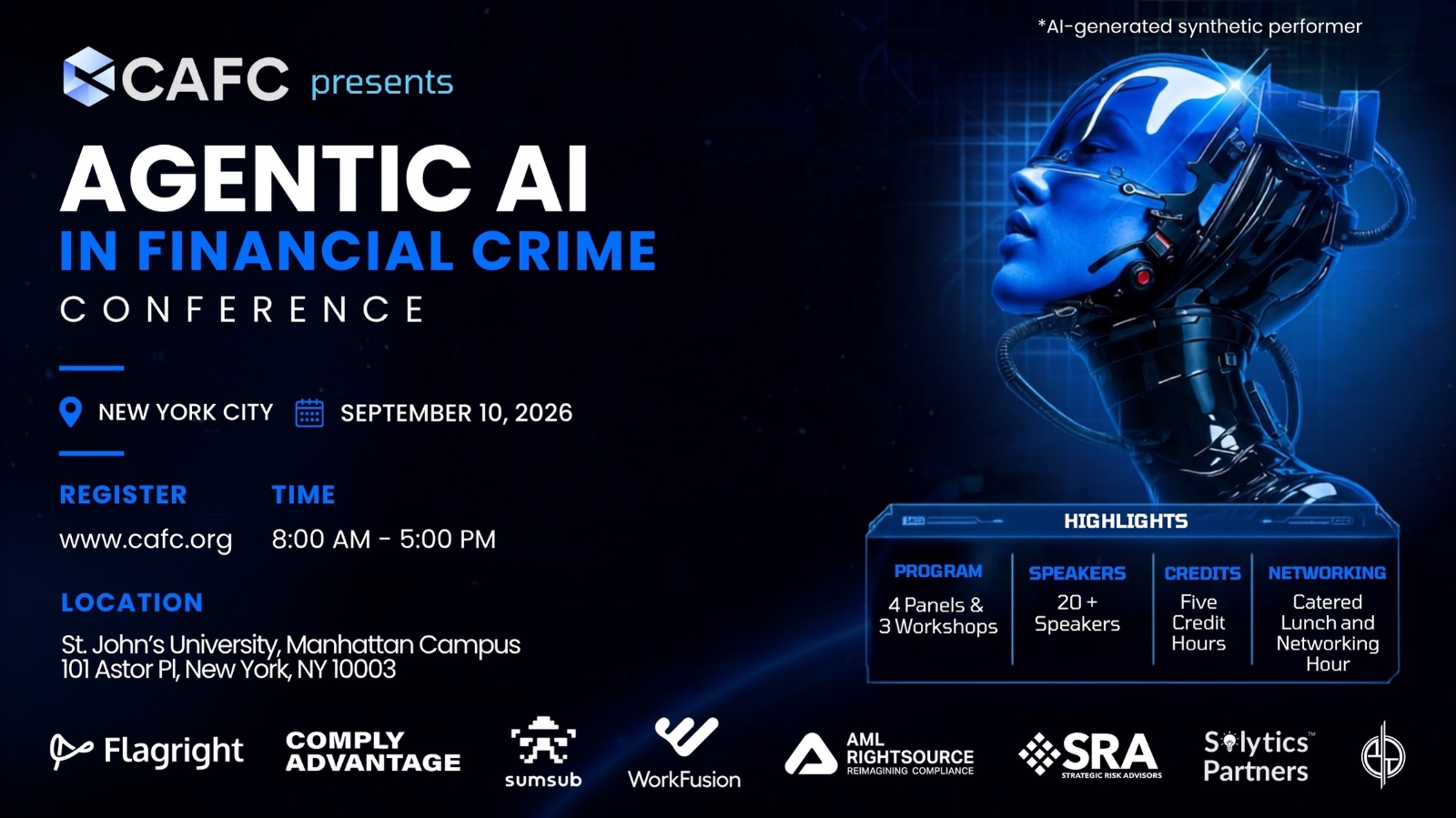

The Agentic AI in Financial Crime Conference brings together financial crime practitioners, compliance leaders, and technology experts for one focused day. The subject is one the industry can no longer defer, the shift from rules-based systems to AI-driven and agentic compliance programs.
Four panels. Four conversations the industry needs to have.
Where is AI delivering real value today? What do governance and model risk frameworks actually need to look like? How do you navigate vendor selection without getting burned? And what does it take to build AI programs that hold up under audit and regulatory scrutiny?
The Agentic AI in Financial Crime Conference is a discussion about where AI is heading, a practical conversation about where it is now, and what responsible deployment looks like in practice.
Proudly Sponsored By:
SRA Consulting supports more than 200 mid-market banks across the United States, delivering award-winning, end-to-end AI risk governance, monitoring, and third-party AI certification solutions. The firm has also developed an agentic platform designed to continuously monitor AI risk, including model drift, data leakage, and hallucinations.
Agenda
This panel examines the evolution of financial crime programs from traditional rules-based systems to advanced AI-driven and agentic capabilities. Panelists will discuss where AI is delivering measurable value today, how institutions are operationalizing AI at scale, and the path toward more autonomous, intelligent systems.
This panel focuses on the governance structures and model risk management practices required to support the responsible use of AI in financial crime programs. Speakers will outline regulatory expectations and provide practical approaches to building defensible, well-controlled AI frameworks.
This panel addresses the practical challenges financial institutions face when selecting, validating, and implementing AI solutions. Panelists will share lessons learned from real-world deployments, including vendor risk considerations, integration challenges, and common implementation pitfalls.
This panel explores how financial institutions can demonstrate that their AI models are transparent, auditable, and defensible. Discussion will focus on the documentation, controls, and evidence required to satisfy internal audit functions and regulatory scrutiny.
Speakers
John C. Calderon - Moderator
Founder & Chair, Coalition Against Financial Crime (CAFC)
John Calderon is a financial crime and compliance executive with nearly 15 years of experience leading BSA/AML, sanctions, and consumer compliance programs across banks, fintech, and money services businesses. He has served as Chief Compliance Officer and BSA Officer, with a strong track record of building and remediating complex compliance frameworks under regulatory scrutiny, including consent orders and enforcement actions. He has led large-scale AML transformations, including the implementation of AI-driven transaction monitoring systems that improve detection and reduce false positives, and brings deep expertise in high-risk banking areas.
Aadesh Gandhre
General Auditor and Chief Audit Executive at The Depository Trust & Clearing Corporation (DTCC)
Aadesh Gandhre is the General Auditor and Chief Audit Executive at DTCC, leading its global Internal Audit function. An award-winning leader, he is driving a tech-powered transformation by embedding analytics, automation, and AI across the audit lifecycle. Previously, Aadesh held senior audit and innovation leadership roles at Société Générale and Goldman Sachs. Recognized by the IIA as the 2026 Chief Audit Executive of the Year, he serves on multiple boards and holds a master's in Computer Science.
Goutam Gandhi
Chief Technology and AI Strategy Officer, SRA Consulting LLC
Goutam Gandhi leads enterprise AI strategy, AI risk management, and innovation across financial services. He also serves in a CISO capacity, overseeing cybersecurity and technology risk. With more than 25 years of experience spanning the Federal Reserve, Bank of America, Wells Fargo, and high-growth fintechs, Goutam has built scalable banking operations that balance the speed of modern payments with the stability, discipline, and trust required by regulated institutions. He has also led AI-driven transformation initiatives, embedding responsible AI and governance into core banking operations, and designing execution frameworks that strengthen controls and reduce regulatory exposure.
Abhishek Mittal
EVP, Chief Product and AI Officer at AML RightSource
Abhishek Mittal is EVP, Chief Product and AI Officer at AML RightSource, leading product innovation and AI-enabled transformation across global compliance services. He brings over 20 years of experience spanning financial services, regulatory technology, decision science, and artificial intelligence. Previously, Abhishek held senior leadership roles at Wolters Kluwer, launching award-winning AI products across a $1B+ portfolio, and managed risk workflows at American Express. He holds a Master’s from IIT Bombay and frequently speaks on compliance innovation.
Alexander Aronov
Compliance, Surveillance, and AI Governance Leader at Citi
Alexander Aronov is a compliance, surveillance, and AI governance leader at Citi, focusing on Compliance Innovation and AI Execution. He specializes in building next-generation compliance frameworks through AI-driven controls and emerging technology governance. Previously, he served as Global Head of Surveillance Intelligence at Citi and held senior leadership roles at Goldman Sachs, JPMorgan Chase, HSBC, and FINRA. A licensed attorney admitted to the NY and NJ Bars, Alexander holds a J.D. from New York Law School.
C. Rob DeCampos, CAMS
Chief Compliance Officer and Head of Payments Compliance at X
C. Rob DeCampos, CAMS is the Chief Compliance Officer and Head of Payments Compliance at X, leading compliance strategy and scalable governance for financial innovation. He brings deep expertise across BSA/AML compliance, enterprise risk, and fintech operations. Previously, Rob served as Chief Compliance Officer and Senior Vice President at Western Union, and held senior compliance leadership roles at Intuit, PayPal, and American Express. He holds a J.D. from Northeastern University and is a Certified Anti-Money Laundering Specialist.
Deepthi Machavaram
Executive Director and Global Head of Digital Financial Crimes Advisory at Morgan Stanley
Deepthi Machavaram is Executive Director and Global Head of Digital Financial Crimes Advisory at Morgan Stanley, focusing on financial crime risk, digital assets, and emerging technology compliance. She brings deep experience across AML advisory, fintech risk, and service delivery. Previously, Deepthi served as Director of Enterprise Digital Assets at BNY Mellon and Global Head of AML FinTech and Crypto Advisory at MUFG. She holds MBA degrees from UNC Kenan-Flagler Business School and the Indian School of Business.
Dinusha Briley
Executive Data and Technology Leader at Navy Federal Credit Union
Dinusha Briley is Senior Manager of Data Engineering, Security at Navy Federal Credit Union, specializing in building enterprise-scale, governed data ecosystems in highly regulated environments. She built Navy Federal’s first end-to-end fraud data ecosystem, converting fragmented data into trusted, decision-ready assets. A people-first leader, Dinusha focuses on aligning data strategy with fraud prevention, physical security, and regulatory compliance. She holds a bachelor's from the University of Maryland and completed executive education through MIT and Cornell.
Sourit Dasgupta, CAMS
Global Head of AML Governance, Risk and Analytics at Interactive Brokers
Sourit Dasgupta, CAMS is Global Head of AML Governance, Risk and Analytics at Interactive Brokers, leading financial crimes compliance across a global brokerage and digital asset ecosystem. He brings over 13 years of experience in AML/CFT, sanctions, and model governance. Sourit specializes in integrating AI, machine learning, and advanced analytics into transaction monitoring. Previously, he held compliance roles at EY and Deloitte. He holds a master's in Computer Science and is a Certified Anti-Money Laundering Specialist.
Victor Salazar, CAMS, ICA
Director of AML Compliance Testing at Mizuho Americas
Victor Salazar, CAMS, ICA is Director of AML Compliance Testing at Mizuho Americas, supporting the evaluation of financial crime compliance controls. He brings extensive experience in AML compliance testing, risk assurance, and banking operations. Victor has held progressively senior roles at Mizuho Americas, including Assistant Vice President and Vice President. Previously, he served as a Compliance Officer at HSBC and held client relationship roles at JPMorgan Chase. He is a Certified Anti-Money Laundering Specialist.
St. John's University, Manhattan Campus New York,
NY
10003United States+ Google Map
Frequently Asked Questions
The Agentic AI in Financial Crime Conference is a full-day, practitioner-focused event hosted by the Coalition Against Financial Crime (CAFC). The conference brings together financial crime professionals, compliance leaders, risk executives, model risk teams, investigators, auditors, technology leaders, and AI practitioners to discuss how artificial intelligence is being deployed, governed, challenged, validated, and operationalized across financial crime programs.
AI is no longer a theoretical discussion for financial crime compliance. It is already changing how institutions detect suspicious activity, investigate alerts, manage sanctions risk, conduct due diligence, govern models, and structure the future financial crime workforce.
Date: Thursday, September 10, 2026
Time: 8:00 AM – 5:00 PM
Location: St. John’s University, Manhattan Campus
Address: 101 Astor Place, New York, NY 10003
This conference is designed for professionals working in or supporting financial crime compliance, including BSA/AML professionals, sanctions professionals, fraud leaders, compliance officers, risk managers, model risk professionals, internal auditors, investigators, technology leaders, AI governance professionals, vendor risk professionals, regulators, law enforcement professionals, consultants, attorneys, and financial crime technology providers.
The event is especially relevant for professionals actively considering, deploying, or overseeing AI-driven solutions in financial crime programs.
The NYC conference will focus on practical, governance-driven conversations around AI in financial crime compliance, including:
AI in financial crime: moving from rules-based systems to intelligence-driven programs
Real-world AI use cases in AML, sanctions, fraud, investigations, and alert triage
AI governance and model risk management
Vendor due diligence and implementation realities
Explainability, auditability, effectiveness, and defensibility
Human oversight and accountability
The future of financial crime professionals in an AI-driven world
AI agents, case automation, and emerging hybrid AML/AI roles
The NYC conference will include:
4 expert-led panels
3 breakout sessions
Catered lunch
Networking opportunities
Real conversations with AFC, compliance, risk, audit, technology, and AI leaders
The conference is designed to prioritize real-world implementation, governance, oversight, and practitioner-level discussion rather than vague AI hype or sales-driven presentations.
This is a practitioner-first event. While technology providers, consultants, and sponsors may participate, the conference is designed around the real questions financial institutions, compliance teams, risk teams, audit teams, and financial crime professionals are facing as AI becomes embedded in financial crime operations.
The goal is to move beyond generic AI discussions and focus on governance, implementation, defensibility, vendor risk, oversight, and operational readiness.
Yes. The NYC conference will include dedicated networking opportunities, including a networking hour. Attendees will have the opportunity to connect with financial crime professionals, compliance leaders, technology providers, AI governance experts, investigators, auditors, and other industry stakeholders.
Yes. Catered lunch will be provided.
The dress code is business casual. Attendees are encouraged to dress professionally and comfortably for a full day of panels, breakout sessions, and networking.
The NYC conference is expected to host approximately 150 attendees.
Registration is now open. Interested attendees are encouraged to register ASAP to take advantage of early-bird pricing which ends on 08/28/2026.
Registration is available through CAFC’s official website under events.
Please visit www.cafc.org for updates.
Yes. Speaking opportunities may be available depending on panel needs, topic fit, and remaining availability.
For speaking inquiries, contact info@cafc.org.
Yes. Sponsorship opportunities are available for organizations interested in supporting the conference and engaging with financial crime, compliance, risk, audit, technology, and AI professionals.
For sponsorship inquiries, contact info@cafc.org.
The conference is designed to avoid vague AI hype and sales-driven presentations. The focus is on real-world financial crime use cases, governance challenges, implementation realities, vendor risk, auditability, explainability, and defensibility.
A certificate of participation for Five (5) continuing education credits will be provided to all attendees after the event.
Attendees should bring a valid photo ID, business cards or contact information for networking, and any materials they may need for note-taking.
At this time, the NYC conference is being promoted as an in-person event.
The conference is hosted by the Coalition Against Financial Crime (CAFC), a professional organization serving the anti-financial crime community through events, education, certifications, thought leadership, and industry engagement.
Yes. Vendors, consultants, law firms, technology providers, recruiters, and other service providers supporting the financial crime compliance industry are welcome to attend. However, vendors are required to purchase a vendor admission ticket.
This is a practitioner-first conference designed to foster substantive conversations around AI governance, implementation, oversight, defensibility, and financial crime program readiness. To preserve the integrity of that environment, CAFC maintains separate admission categories for practitioners and vendors.
Vendor pricing is higher because vendors attend with a commercial interest and benefit from access to a highly targeted audience of financial crime, compliance, risk, fraud, sanctions, audit, and technology decision-makers.
No. A vendor admission ticket does not include sponsorship benefits, exhibit space, a speaking role, branding, product demonstration opportunities, or lead-generation rights. Those opportunities are reserved for official sponsors.
Vendors who purchase general vendor admission may attend, learn, network appropriately, and participate in the conference experience. However, they may not engage in suitcasing, unauthorized solicitation, product demonstrations, distribution of marketing materials, or any activity that functions as an unofficial exhibit or sponsorship.
Vendors who purchase a practitioner ticket will not be admitted under that ticket type and may be invoiced for the difference in ticket price. If the difference is not paid upon request, the ticket may be cancelled and refunded minus a 25% administrative fee, along with any applicable payment processing and ticketing fees.
For event updates, registration announcements, speaking opportunities, and sponsorship information, visit www.cafc.org.
For direct inquiries, contact info@cafc.org.