


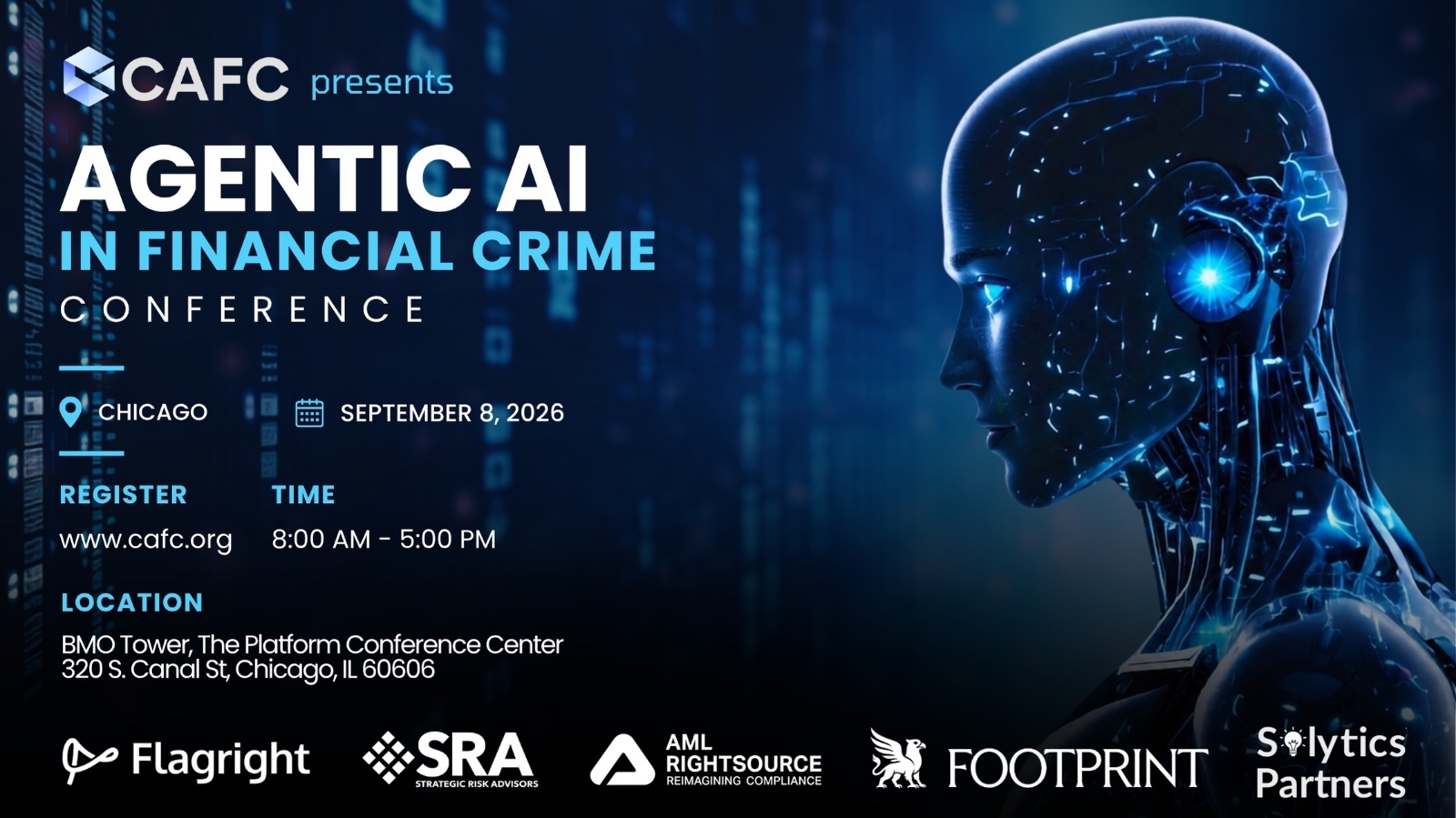
Agentic AI in Financial Crime Conference – Chicago
A full day on how AI is actually being deployed, governed and defended inside financial crime programmes. Built for practitioners, not vendors.
What you will take away
- Where AI is delivering measurable value in AML and fraud today, and where the hype outpaces reality.
- What a defensible AI governance and model risk framework looks like as systems gain autonomy.
- How to run vendor due diligence without importing new compliance or regulatory risk.
- How to make AI-enabled programmes explainable, auditable and ready for regulatory scrutiny.
Overview
What this conference is
A practitioner-led examination of how artificial intelligence is reshaping financial crime risk management, run by the Coalition Against Financial Crime.
The Agentic AI in Financial Crime Conference brings together senior leaders from financial institutions, compliance and risk functions, law enforcement, and leading technology providers for a focused, practical examination of how artificial intelligence is reshaping financial crime risk management. Criminals are already using AI to scale fraud, automate attacks, and develop increasingly sophisticated methods of evasion. Institutions that fail to modernize risk defending against tomorrow’s financial crime with yesterday’s detection methods.
That reality is accelerating the need for financial institutions to adopt AI capabilities of their own. AI is no longer an emerging technology sitting on the sidelines of compliance; it is already being applied across AML, fraud, sanctions, KYC, investigations, transaction monitoring, and operational decision-making. At the same time, agentic AI is introducing a new level of autonomy, complexity, and governance risk. The question is no longer whether organizations will adopt AI, but how they can deploy it responsibly, effectively, and defensibly.
Through four substantive panel discussions and multiple workshops, the conference will tackle the questions financial crime leaders are being forced to answer now:
- Where is AI delivering measurable value today, and where is the hype outpacing reality?
- What should effective AI governance and model risk management look like as systems become more autonomous?
- How can institutions evaluate, select, and implement AI vendors without creating new compliance, operational, or regulatory risks?
- What does it take to build AI-enabled financial crime programs that are explainable, auditable, defensible, and capable of withstanding regulatory scrutiny?
The conference is designed to move beyond high-level discussions about the future of AI. Attendees will hear directly from practitioners who are implementing, governing, testing, and overseeing these technologies in real-world environments. Expect candid conversations around governance, human oversight, model risk, explainability, validation, vendor due diligence, implementation challenges, regulatory expectations, and the practical realities of moving AI initiatives from pitch to production.
The Agentic AI in Financial Crime Conference is where financial crime, risk, compliance, and technology leaders come together to separate what is possible from what is practical—and define what responsible AI deployment should look like as the industry enters its next phase.
Audience
Who it is for
Built for the people accountable for detection, governance and defensibility. If you are weighing an AI deployment or already have one under review, this is your room.
You should attend if you are
- A BSA/AML or financial crime compliance officer
- A financial intelligence analyst or investigator
- A model risk, audit or validation lead
- A fraud, sanctions or KYC programme owner
- A compliance leader responsible for regulatory readiness
What you should bring
- A live AI question your programme has not answered yet
- Context on your current detection and monitoring stack
- Any vendor evaluation you are midway through
- Your governance framework, for comparison in the workshops
- Questions for the panel, submitted ahead via Contact Us
Themes
Key focus areas
Contents
Table of Contents
The full running order for the day. Breakout workshops run in parallel; you choose one of three.
-
01
8:00 AM – 8:45 AM
Check-in / Registration
Check in, pick up your conference materials and name badge, and enjoy light refreshments before the program begins. This is your first opportunity to connect with fellow attendees, speakers, and sponsors in a more…
-
02
8:45 AM – 9:00 AM
Opening Remarks
Welcome from CAFC conference leadership, setting the tone for the day ahead. This session outlines the agenda, introduces key themes, and frames the conversations that will shape the rest of the conference.
-
03
9:00 AM – 9:50 AM
AI in Financial Crime: From Rules to Intelligence
This panel examines the evolution of financial crime programs from traditional rules-based systems to advanced AI-driven and agentic capabilities. Panelists will discuss where AI is delivering measurable value today, how institutions are operationalizing AI…
-
04
9:50 AM – 10:40 AM
AI Governance and Model Risk: Building a Defensible Framework
This panel focuses on the governance structures and model risk management practices required to support the responsible use of AI in financial crime programs. Speakers will outline regulatory expectations and provide practical approaches to…
-
05
10:40 AM – 11:00 AM
Coffee Break
Refresh, recharge, and connect during a brief networking break. This short break intends to give you dedicated time to continue conversations with peers, engage with speakers, and explore what sponsors have to offer.
-
06
11:00 AM – 12:00 PM
Breakout Workshops (Choose One of Three)
Select one of three concurrent interactive workshops, each focused on a specialized topic within AI governance and financial crime compliance. Sessions are designed for hands-on engagement, practical application, and direct dialogue with facilitators and…
-
07
12:00 PM – 1:00 PM
Catered Lunch
Enjoy a complimentary catered lunch while continuing conversations and building professional connections with attendees and speakers. Whether you're following up on a panel discussion or making new connections, lunch is one of the most…
-
08
1:00 PM – 1:50 PM
From Pitch to Production: Vendor Due Diligence and Implementation Realities
This panel addresses the practical challenges financial institutions face when selecting, validating, and implementing AI solutions. Panelists will share lessons learned from real-world deployments, including vendor risk considerations, integration challenges, and common implementation pitfalls.
-
09
1:50 PM – 2:40 PM
Prove It: AI Explainability, Auditability, and Defensibility
This panel explores how financial institutions can demonstrate that their AI models are transparent, auditable, and defensible. Discussion will focus on the documentation, controls, and evidence required to satisfy internal audit functions and regulatory…
-
10
2:40 PM – 3:00 PM
Awards Ceremony & Closing Remarks
Celebrate outstanding contributions, hear final conference takeaways, and conclude the formal program. This session gives attendees a summary of the day's most important insights and action points.
-
11
3:00 PM – 5:00 PM
Networking Social
The formal program may be over, but the conversations are just getting started. Join speakers, sponsors, and fellow attendees for a relaxed networking social, the ideal setting to continue discussions and build lasting professional…
-
12
5:00 PM
Event Concludes
Thank you for attending the Agentic AI in Financial Crime Conference. We hope today's sessions leave you with sharper frameworks, stronger connections, and a clearer sense of where AI governance in financial crime is…
Speakers
Who you will hear from
Select any speaker for their full biography.

John C. Calderon
Founder & Chair, Coalition Against Financial Crime (CAFC)
John Calderon is a financial crime and compliance executive with nearly 15 years of experience leading BSA/AML, sanctions, and consumer compliance programs across banks, fintech, and money services businesses. He has served as Chief Compliance Officer and BSA Officer, with a strong track record of building and remediating complex compliance frameworks under regulatory scrutiny, including consent orders and enforcement actions. He has led large-scale AML transformations, including the implementation of AI-driven transaction monitoring systems that improve detection and reduce false positives, and brings deep expertise in high-risk banking areas.

Mike Jones
Chief Compliance Officer, Partner, SRA Consulting LLC
Mike Jones is a Partner at SRA Consulting, leading financial crimes and regulatory compliance services and serving as interim Chief Compliance Officer and BSA Officer for banks and fintechs. With nearly 25 years of experience, he has advised institutions ranging from $400 million institutions to some of the largest US banks on compliance, risk management, BaaS, digital assets, and AI. A former US Army officer, Mike has led remediation efforts, managed teams of 1,500, and supported compliance due diligence for acquisitions totaling approximately $7 billion. He holds an MBA from Duke University’s Fuqua School of Business, a BS from the United States Military Academy at West Point, and is both CRCM- and CAMS-certified

Peter Sweeney
Head of GTM Strategy, Footprint
Peter Sweeney is Head of GTM Strategy at Footprint, the AI operating system for risk. Footprint gives compliance teams at leading banks and fintechs the end-to-end agentic infrastructure to review more cases, in more depth, in less time. As a Wharton alum and former Goldman Sachs investment banker, Sweeney has built his career at the intersection of finance, product, and growth. Before Footprint, he co-founded ALAO Loyalty, a loyalty management software company acquired by Commonwealth Markets.

Christopher Phillips
Director of Financial Crime Industry Engagement, Flagright
Christopher Phillips is a financial crime compliance leader with nearly 20 years building and transforming AML, sanctions, and fraud programs across banking, fintech, trading, and payments. Having led large, distributed analyst and investigator teams across the US and Europe, he turns complex, messy programs into sharper, faster operations through automation, machine learning, and AI. A frequent speaker and published author, Christopher focuses on practical, scalable controls, and how AI-native platforms are redefining investigation workflows and suspicious activity detection.

Ken Triemstra
AML & Sanctions Executive, Compliance, Block
Ken Triemstra, MBA, CAMS, is the Enterprise AML and Sanctions Program Lead at Block, overseeing financial crime compliance across the company's payments and digital financial services ecosystem. With more than 20 years of experience spanning AML, sanctions, KYC, and customer due diligence, Ken has held senior global compliance roles at Citi, State Street, and JPMorgan Chase, including Global Head of KYC Compliance and Head of AML Transformation. He has led complex regulatory programs and large-scale transformation initiatives across multiple countries and business lines.

Dr. Lubomira Minkovsky
SVP, Head of Model Development & AI, Northern Trust Corporation
Lubomira Ivanova Minkovsky, Ph.D., is Senior Vice President and Head of Model Development and AI within Risk at Northern Trust, leading a global team responsible for credit risk, market risk, and balance-sheet projection models for regulatory purposes, alongside advanced analytics initiatives involving machine learning and generative AI. With more than 20 years of experience in data science, statistical modeling, and financial risk, she holds a Ph.D. in Finance from Northwestern University's Kellogg School of Management and the FRM, PRM, and RAI credentials.

Jennie Jonas
SVP, Global Head, Financial Crimes Advisory, AML Rightsource
Jennie Jonas is Senior Vice President and Global Head of Financial Crimes Advisory at AML RightSource, leading advisory services across AML, sanctions, fraud, data analytics, model risk, and emerging technology. With more than 20 years of experience, she has helped financial institutions strengthen financial crime programs and improve detection through risk-based governance and data integrity. Previously, Jennie served as Managing Director of Financial Crimes and Analytics at KPMG US and as VP of BSA/AML and OFAC Compliance at Synchrony in both the US and the UK. She holds a degree in Accounting from Cardiff University and is a Certified Fraud Examiner.

Thephil Russelliah Roby
VP, Risk & Compliance, Onbe
Thephil Russelliah Roby is Vice President of Risk and Compliance at Onbe, serving as board-appointed Compliance Officer, Data Protection Officer, and AML/Sanctions Officer. With more than 20 years of experience, she leads enterprise risk management, consumer compliance, privacy, and financial crime programs across the US, Canada, EMEA, and APAC. Previously, she held senior roles at Discover Financial Services and BMO Financial Group, building and transforming AML, sanctions, and governance programs. She holds an MBA from DePaul University, completed Yale School of Management’s Executive Leadership Program, and is both CRCM- and CAMS-certified.

Ashish Aggarwal
Managing Director, Data, Analytics & Gen AI Transformation
Ashish Aggarwal is an enterprise AI, data, and analytics transformation executive with extensive experience helping highly regulated financial institutions modernize their technology, governance, and decision-making capabilities. Most recently, he served as Managing Director of Data, Analytics and GenAI Transformation at CIBC US, leading initiatives in generative AI, intelligent automation, cloud-native analytics, and data governance. Previously, Ashish held senior roles at Freddie Mac, Northern Trust, and Regions Bank, overseeing more than 160 AI and machine-learning models and leading global teams across North America, EMEA, and APAC.

Carrie Gilson
SVP, EFCC FIU Director, U.S. Bank
Carrie Gilson brings over 20 years of progressive experience in financial services, with leadership roles at JPMorgan Chase, KeyBank, and U.S. Bank, and a specialized focus on financial crimes compliance and analytics. She has a proven track record managing teams across AML, OFAC, KYC, and fraud programs, with particular expertise in model development, regulatory engagement, and relationship management. Carrie is dedicated to developing innovative AI/ML techniques that identify suspicious activity, reduce false positives, and strengthen the effectiveness of existing detection scenarios. She holds an MBA from Northwestern University's Kellogg School of Management.

Michelle Koper
Director, Global Transaction Monitoring, BMO
Michelle Koper is Director of Global Transaction Monitoring at BMO, where she provides strategic leadership for the development, maintenance, and governance of the bank’s global AML transaction monitoring program. She specializes in transforming financial crime detection through machine learning, network and graph analytics, predictive modeling, and other advanced technologies. Since joining BMO in 2014, Michelle has held several leadership roles across AML modeling, machine learning, and model management. She holds an MBA from Alverno College and a Bachelor of Business Administration in Finance from the University of Wisconsin–Milwaukee.

Noordin Tharani
Chief AML Officer (interim), Interactive Brokers
Noordin Tharani is Interim Chief AML Officer and Deputy Chief AML Officer at Interactive Brokers, bringing deep expertise in AML, counter-terrorist financing, sanctions, enhanced due diligence, enterprise risk assessments, and compliance technology. Previously, he served as Director of Financial Crimes Compliance at CIBC U.S., where he was the board-appointed BSA Officer for multiple private wealth and trust entities, and held AML and risk roles at SunTrust and JPMorgan Chase. Noordin holds a JD from Case Western Reserve University School of Law and is a Certified Anti-Money Laundering Specialist.

Paulina Peters
Deputy BSA Officer, Old National Bank
Paulina M. Peters is Vice President and Deputy BSA Officer at Old National Bank, supporting enterprise oversight of AML, sanctions, and financial crime compliance. With more than 20 years of experience spanning program governance, risk assessments, investigations, and regulatory remediation, she previously served as the board-appointed BSA/AML Officer at CNB Bank & Trust, where she led the successful remediation of an OCC consent order. Paulina has also held senior roles at BMO and GE Capital and serves as Chair of the ACAMS Chicago Chapter Board.

Richard Paskis
Director, U.S. Financial Intelligence Unit, BMO
Richard Paskis is Director of the U.S. Financial Intelligence Unit at BMO Financial Group, where he leads financial intelligence and anti-money laundering operations. He brings more than three decades of banking experience spanning AML investigations, high-risk customer management, commercial lending, credit risk, and special assets. During his more than 20 years with BMO, Richard has held several leadership roles across financial crime compliance and commercial banking. He earned a Bachelor of Science in Finance from Indiana University’s Kelley School of Business.

Robert Reed
Chief Operations Officer, International Bank of Chicago
Robert M. Reed is Chief Operating Officer at International Bank of Chicago, overseeing bank operations, regulatory controls, and a growing e-commerce payments business. With more than 25 years of experience across banking operations, BSA/AML compliance, enterprise risk, and fintech, he is known for turning regulatory pressure into durable operating capability. Previously, Robert held senior roles at Ankura, BMO Capital Markets, BMO Financial Group, and OCC. He holds an MBA from the University of Notre Dame and is CAMS- and CAPFC-certified.

Mark Szott
Head of AML Models & Rules, Meta
Mark Szott drives efforts to improve and develop AML models for new products and to address gaps and risks identified across the full AML model suite, including transaction monitoring, event and relationship risk, and customer risk rating. He works collaboratively with a dynamic group of cross-functional stakeholders including Legal, Product, Engineering, Finance, and Marketing, to build innovative, scalable AML compliance systems and processes that harness the transactional power of Facebook, Instagram, WhatsApp, Messenger, and other Meta platforms.

Iskra Sbraccia
Head of Sanctions Screening Operations, Google
Iskra Sbraccia brings over 20 years of experience leading compliance risk management, overseeing sanctions governance, screening technologies, and operations. A certified Sanctions Specialist, she has led transformative initiatives including global content and data management systems, third-party vendor risk assessments, and AML and sanctions governance. Her leadership emphasizes collaboration and transparent communication across regions and functions, driven by strategic foresight and innovation to advance organizations through a dynamic regulatory landscape.

Kathleen Bell
Director of AI/ML & AML Model Development, BMO
Kathleen Bell is Director of AI/ML and AML Model Development at BMO Financial Group, where she leads the development and application of advanced analytics and machine learning solutions within financial crime compliance. She brings nearly three decades of experience in data science, predictive modeling, and analytics leadership across the financial services and marketing industries. Kathleen is skilled at identifying high-value business challenges, developing strategic innovation roadmaps, and translating complex data into actionable insights for executive decision-makers. She holds a Master of Science in Applied Economics and a Bachelor of Arts in Political Science from Marquette University.

Larry Massen
Director, Financial Crimes Risk Management, AML Market Integrity, Charles Schwab
Larry Massen serves as the Director of AML Integrity within the Financial Crimes Risk Management department at Charles Schwab & Company, working out of Chicago. His team investigates market manipulation in the stock market, along with securities deposit fraud schemes. Now in his eighteenth year at Schwab, Larry previously held financial crime roles at Peak6 here in Chicago and Apex Clearing Corporation in Dallas, Texas. Before transitioning into financial crimes, he spent nine years working in the United States Senate in Washington, D.C. Larry earned a Bachelor’s Degree in Political Science from the University of Wisconsin-Madison and a Law Degree from American University’s Washington College of Law.

Patrick Bowe
Head of Product, Solytics
Patrick Bowe is Head of Product at Solytics Partners and a senior financial crime transformation leader with more than 20 years of experience across banking, RegTech, and consulting. His background spans AML, KYC, transaction monitoring, sanctions, case management, and financial crime product strategy, with leadership roles at organizations including AML RightSource, Nasdaq, ING, and Standard Chartered Bank.
At Solytics Partners, Patrick focuses on helping financial institutions improve how they detect, investigate, and manage financial crime risk through AI-driven compliance technology. He brings a practical perspective on transformation, governance, target operating models, and the deployment of AI and machine learning across regulated financial crime workflows.

William Eisenmenger
AML Transaction Monitoring Lead, Google
William Eisenmenger is the AML Transaction Monitoring Lead for Payments Compliance at Google, where he applies advanced analytics, statistics, and machine learning to financial crime risk management. He brings more than a decade of experience across AML/BSA compliance, quantitative modeling, transaction monitoring, KYC, sanctions screening, and model validation.
Previously, William held senior analytics and modeling roles at U.S. Bank and KeyBank, where he led teams responsible for AML model development, OFAC screening, customer risk assessment, and the deployment of machine learning solutions to improve transaction monitoring effectiveness. He holds a B.S. in Mathematics from Case Western Reserve University and is a Certified Anti-Money Laundering Specialist.
Coalition Against Financial Crime
Chicago
cafc.org
info@cafc.org
Proudly sponsored by




Registration
Reserve your seat
Complete the form and we will send your joining details by email. Seats are limited and allocated in order of registration.
- Full-day access to all panels and one breakout workshop
- Catered lunch and the afternoon networking social
- Discounted rates for CAFC members
- Counts toward recertification requirements
Logistics
Date, venue and organiser
Timing
- September 8, 2026
- 8:00 am – 5:00 pm
- From $200 · see all CAFC events
Venue and organiser
- Chicago
BMO Tower, The Platform Conference Center, 320 S. Canal Street, Chicago, IL 60606, United States - Coalition Against Financial Crime
- info@cafc.org
FAQ
Common questions
The Agentic AI in Financial Crime Conference is a full-day, practitioner-focused event hosted by the Coalition Against Financial Crime (CAFC). The conference brings together financial crime professionals, compliance leaders, risk executives, model risk teams, investigators, auditors, technology leaders, and AI practitioners to discuss how artificial intelligence is being deployed, governed, challenged, validated, and operationalized across financial crime programs.
This is not another “AI is coming” conference. AI is already here. The question is whether your program is ready to govern it, challenge it, implement it, audit it, and defend it.
Date: Tuesday, September 8, 2026
Time: 8:00 AM – 5:00 PM
Location: 320 S. Canal Street Chicago, Illinois 60606
Tower: BMO Tower, The Platform Conference Center
This conference is designed for professionals working in or supporting financial crime compliance, including BSA/AML professionals, sanctions professionals, fraud leaders, compliance officers, risk managers, model risk professionals, internal auditors, investigators, technology leaders, AI governance professionals, vendor risk professionals, regulators, law enforcement professionals, consultants, attorneys, and financial crime technology providers.
The event is especially relevant for professionals actively considering, deploying, or overseeing AI-driven solutions in financial crime programs.
The Chicago conference will focus on practical, governance-driven conversations around AI in financial crime compliance, including:
- AI in financial crime: moving from rules-based systems to intelligence-driven programs
- Real-world AI use cases in AML, sanctions, fraud, investigations, and alert triage
- AI governance and model risk management
- Vendor due diligence and implementation realities
- Explainability, auditability, effectiveness, and defensibility
- Human oversight and accountability
- The future of financial crime professionals in an AI-driven world
- AI agents, case automation, and emerging hybrid AML/AI roles
CAFC reserves the right, in its sole discretion, to accept, decline, cancel, or revoke any registration or admission to a CAFC conference, meeting, roundtable, or other event at any time.
This right includes, but is not limited to, registrations from individuals or organizations whose attendance CAFC determines may present a competitive, commercial, operational, reputational, security, or other business concern, including organizations that offer products, services, memberships, conferences, roundtables, certifications, research, or other programs that compete directly or indirectly with CAFC.
Registration or payment does not guarantee admission. If CAFC cancels a registration prior to the event under this provision, CAFC may issue a refund of the applicable registration fee at its discretion. CAFC also reserves the right to remove an attendee whose conduct, activities, or presence is inconsistent with the purpose, interests, policies, or integrity of the event.
CAFC is not required to disclose or provide a detailed explanation for a decision to decline, cancel, or revoke registration or admission.
The Chicago conference will include:
- 4 expert-led panels
- 3 breakout sessions
- Catered lunch
- Networking opportunities
- Real conversations with AFC, compliance, risk, audit, technology, and AI leaders
The conference is designed to prioritize real-world implementation, governance, oversight, and practitioner-level discussion rather than vague AI hype or sales-driven presentations.
This is a practitioner-first event. While technology providers, consultants, and sponsors may participate, the conference is designed around the real questions financial institutions, compliance teams, risk teams, audit teams, and financial crime professionals are facing as AI becomes embedded in financial crime operations.
The goal is to move beyond generic AI discussions and focus on governance, implementation, defensibility, vendor risk, oversight, and operational readiness.
Yes. The Chicago conference will include dedicated networking opportunities, including a networking hour. Attendees will have the opportunity to connect with financial crime professionals, compliance leaders, technology providers, AI governance experts, investigators, auditors, and other industry stakeholders.
Yes. Catered lunch will be provided.
The dress code is business casual. Attendees are encouraged to dress professionally and comfortably for a full day of panels, breakout sessions, and networking.
The Chicago conference is expected to host approximately 150 attendees.
Registration is now open. Interested attendees are encouraged to register ASAP to take advantage of early-bird pricing which ends on 08/28/2026.
For updates, visit www.cafc.org.
Registration is available through CAFC’s official website under events.
Please visit www.cafc.org for updates.
Yes. Speaking opportunities may be available depending on panel needs, topic fit, and remaining availability.
For speaking inquiries, contact info@cafc.org.
Yes. Sponsorship opportunities are available for organizations interested in supporting the conference and engaging with financial crime, compliance, risk, audit, technology, and AI professionals.
For sponsorship inquiries, contact info@cafc.org.
The conference is designed to avoid vague AI hype and sales-driven presentations. The focus is on real-world financial crime use cases, governance challenges, implementation realities, vendor risk, auditability, explainability, and defensibility.
A certificate of participation for Five (5) continuing education credits will be provided to all attendees after the event.
Attendees should bring a valid photo ID, business cards or contact information for networking, and any materials they may need for note-taking.
At this time, the Chicago conference is being promoted as an in-person event.
The conference is hosted by the Coalition Against Financial Crime (CAFC), a professional organization serving the anti-financial crime community through events, education, certifications, thought leadership, and industry engagement.
Yes. Vendors, consultants, law firms, technology providers, recruiters, and other service providers supporting the financial crime compliance industry are welcome to attend. However, vendors are required to purchase a vendor admission ticket.
This is a practitioner-first conference designed to foster substantive conversations around AI governance, implementation, oversight, defensibility, and financial crime program readiness. To preserve the integrity of that environment, CAFC maintains separate admission categories for practitioners and vendors.
Vendor pricing is higher because vendors attend with a commercial interest and benefit from access to a highly targeted audience of financial crime, compliance, risk, fraud, sanctions, audit, and technology decision-makers.
No. A vendor admission ticket does not include sponsorship benefits, exhibit space, a speaking role, branding, product demonstration opportunities, or lead-generation rights. Those opportunities are reserved for official sponsors.
Vendors who purchase general vendor admission may attend, learn, network appropriately, and participate in the conference experience. However, they may not engage in suitcasing, unauthorized solicitation, product demonstrations, distribution of marketing materials, or any activity that functions as an unofficial exhibit or sponsorship.
Vendors who purchase a practitioner ticket will not be admitted under that ticket type and may be invoiced for the difference in ticket price. If the difference is not paid upon request, the ticket may be cancelled and refunded minus a 25% administrative fee, along with any applicable payment processing and ticketing fees.
For event updates, registration announcements, speaking opportunities, and sponsorship information, visit www.cafc.org.
For direct inquiries, contact info@cafc.org.