


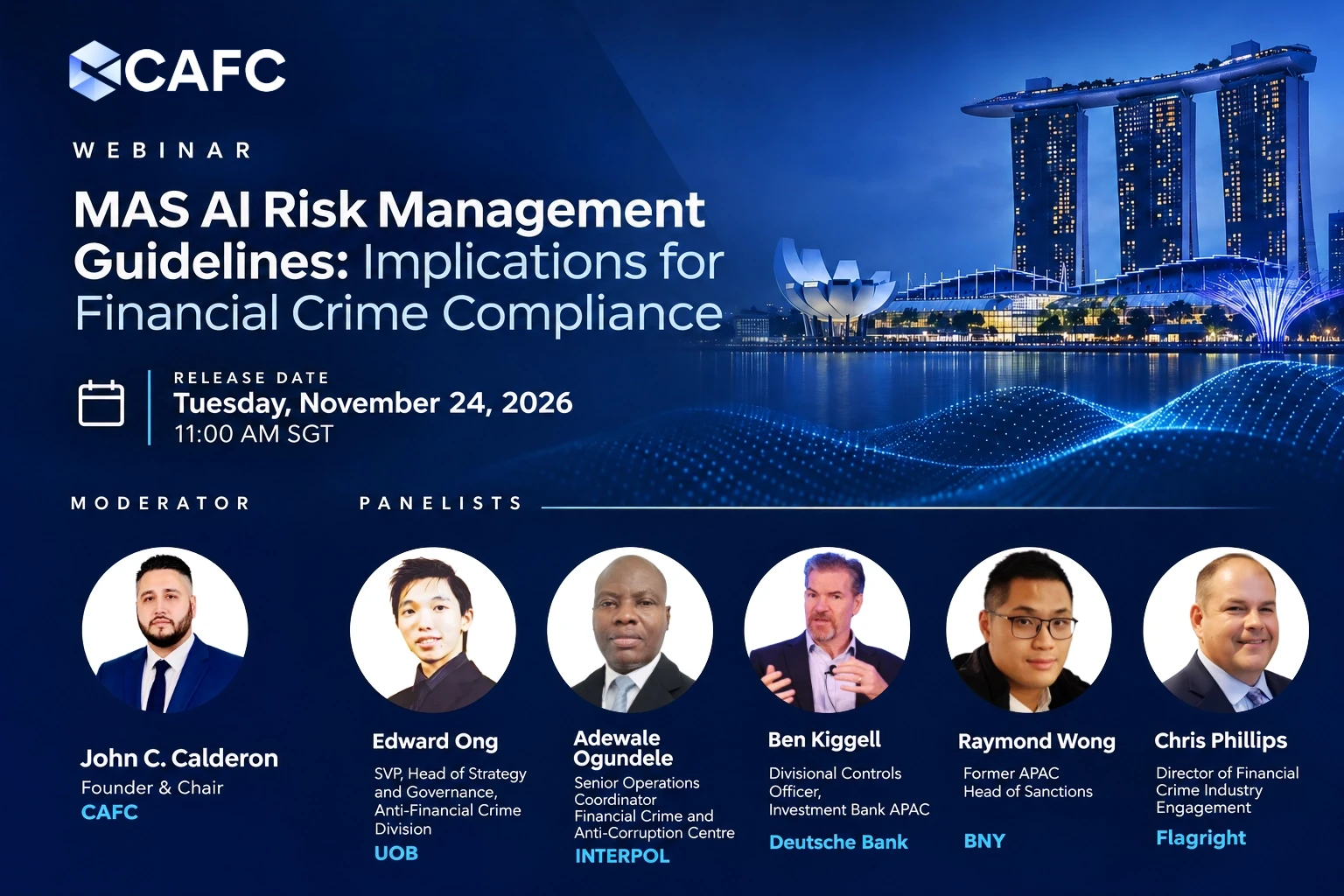
MAS AI Risk Management Guidelines: Implications for Financial Crime Compliance
Singapore's new AI risk management expectations are approaching. Is your financial crime compliance program prepared?
Overview
About this webinar
On October 7, 2026, the Monetary Authority of Singapore (MAS) issued its Guidelines on Artificial Intelligence Risk Management, establishing new expectations for how financial institutions govern, evaluate, validate, and monitor AI systems.
For financial crime compliance teams, the implications are significant. AI is increasingly being deployed across transaction monitoring, sanctions screening, fraud prevention, customer due diligence, and investigations. Our panel explores what the guidelines mean in practice.
Audience
Who it is for
If you deploy, evaluate, buy or govern AI for financial crime compliance, this discussion is for you.
You should watch if you are
- Deploying AI in financial crime compliance
- Evaluating or purchasing AI solutions
- Responsible for AI or model governance
- Preparing for the MAS phases in October 2027 and October 2028
Contents
What we will discuss
The five questions the panel works through.
-
01
Who owns AI risk in financial crime compliance
MAS expects institutions to identify AI use cases, assess their risk materiality, and establish clear governance and accountability. When AI is embedded in sanctions screening or transaction monitoring, should responsibility sit with financial crime…
-
02
Are AI systems actually improving detection
Beyond false positives, operational costs and investigation times, what about false negatives and suspicious activity that goes undetected? How should institutions measure detection effectiveness and set meaningful performance thresholds?
-
03
Can banks rely on vendor testing and validation
As institutions depend on third-party AI solutions, how much assurance should banks require from providers, when is independent validation necessary, and what should they do when vendors cannot fully explain how their models reach…
-
04
Is agentic AI ready for financial crime investigations
AI agents can investigate alerts, analyze transactions and recommend or execute decisions. How much autonomy is too much, and what safeguards keep human oversight and prevent AI-driven errors from creating regulatory or law enforcement…
-
05
What to prioritize before October 2027
With the first phase of the MAS requirements approaching, institutions must evaluate their AI governance frameworks, inventories, accountability structures and risk assessment methods. Each panelist shares one key implementation priority.
Speakers
Who you will hear from
Select a speaker to read a short profile.

John C. Calderon
Founder and Chair, CAFC (Moderator)
John Calderon is a financial crime and compliance executive with nearly 15 years of experience leading BSA/AML, sanctions, and consumer compliance programs across banks, fintech, and money services businesses. He has served as Chief Compliance Officer and BSA Officer, with a strong track record of building and remediating complex compliance frameworks under regulatory scrutiny, including consent orders and enforcement actions. He has led large-scale AML transformations, including the implementation of AI-driven transaction monitoring systems that improve detection and reduce false positives, and brings deep expertise in high-risk banking areas.

Edward Ong
Senior Vice President, Head of Strategy and Governance, Anti-Financial Crime Division, UOB
Edward Ong is an anti-financial crime leader who heads Strategy and Governance in the Anti-Financial Crime Division at UOB in Singapore. An experienced compliance professional in AML/CFT, investigations, process management and regulatory engagement, he previously served at the Monetary Authority of Singapore as Deputy Director in the AML Department, leading AML risk surveillance and analytics. Earlier, he held senior financial crime roles at Standard Chartered Bank, including Head of Singapore Financial Crime Surveillance Operations, and worked in financial crime compliance at Goldman Sachs and Credit Suisse. He holds a Master of Information Technology in Business (Financial Technology and Analytics) from Singapore Management University.

Adewale Ogundele
Senior Operations Coordinator, INTERPOL Financial Crime and Anti-Corruption Centre
Adewale Ogundele is a Senior Operations Coordinator at the INTERPOL Financial Crime and Anti-Corruption Centre (IFCACC), based at the INTERPOL Global Complex for Innovation in Singapore. A serving police officer with the rank of Assistant Commissioner of Police, he has held the role since September 2024, coordinating operational work at the centre against financial crime and corruption.

Ben Kiggell
Divisional Controls Officer, Investment Bank APAC, Deutsche Bank
Ben Kiggell is Divisional Controls Officer for Deutsche Bank Investment Bank in Asia Pacific, where he leads conduct, front office supervision, business governance and reputational risk processes. He designs the supervision processes and tools that help front office supervisors meet regulatory requirements, delivers conduct training across sales, trading and corporate finance, and advises the business on reputational risk early in deal origination. Before joining Deutsche Bank in 2015, he spent around 20 years trading interest rate derivatives in London, Tokyo and Singapore, including at UBS Investment Bank, and also worked at SGX and Bloomberg.

Raymond Wong
Former APAC Head of Sanctions, BNY
Raymond Wong is an APAC sanctions and financial crimes compliance executive based in Singapore. He was most recently APAC Head of Sanctions at BNY, a role he held from 2022 to 2026. Before that, he spent more than five years at Deutsche Bank, progressing to APAC Lead of Sanctions Advisory, Policy and Governance, and earlier worked at Credit Suisse across APAC sanctions, FIU and PEP desk, and private banking anti-money laundering and surveillance roles. He holds the CAMS, CGSS and CSS credentials and studied at the University of Hong Kong.

Chris Phillips
Director of Financial Crime Industry Engagement, Flagright
Christopher Phillips is a financial crime compliance leader with nearly 20 years building and transforming AML, sanctions, and fraud programs across banking, fintech, trading, and payments. Having led large, distributed analyst and investigator teams across the US and Europe, he turns complex, messy programs into sharper, faster operations through automation, machine learning, and AI. A frequent speaker and published author, Christopher focuses on practical, scalable controls, and how AI-native platforms are redefining investigation workflows and suspicious activity detection.
Coalition Against Financial Crime
Online
cafc.org
info@cafc.org
Registration
Register to watch
Registration is free. As soon as the recording is available, we will email you the link to watch it.