


Enforcement impact analysis
Beyond the Fine: How TD Bank’s AML Crisis Affected Growth, Valuation, and Investor Confidence
An event study and cost analysis of the first U.S. bank to plead guilty to money laundering conspiracy
Get the white paper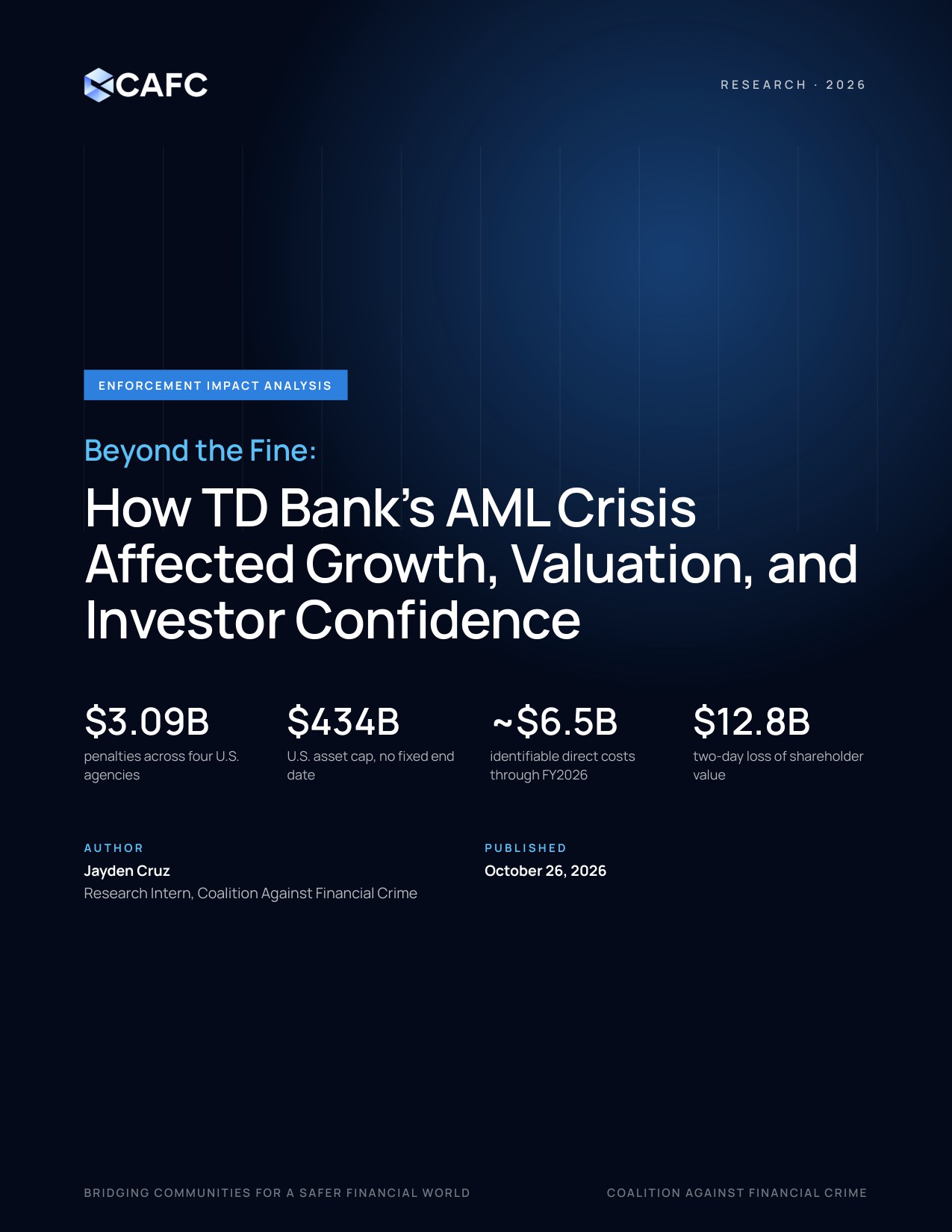
$3.09Bpenalties across four U.S. agencies
$434BU.S. asset cap, no fixed end date
~$6.5Bidentifiable direct costs through FY2026
$12.8Btwo-day loss of shareholder value
7 mo.for the share price to recover
At a glance
The case
On October 10, 2024, TD Bank, N.A. became the first bank in United States history to plead guilty to conspiracy to commit money laundering, resolving a case built on anti-money-laundering deficiencies that ran for more than a decade.
The key finding
The asset cap, more than the fine, changed TD’s investment case.
Inside this paper
- Executive Summary
- TD Bank and Its U.S. Growth Strategy
- The AML Failures
- The Enforcement Action and Financial Consequences
- Stock Market Reaction
- The Asset Cap and TD’s U.S. Growth
- The Counterargument: Why the Stock Recovered
- Putting a Number on It
- What If It Never Happened? A Counterfactual Estimate
- Governance and Accountability
- Lessons for Investors and Financial Institutions
- Conclusion
- Methodology, Sources and About the Author